
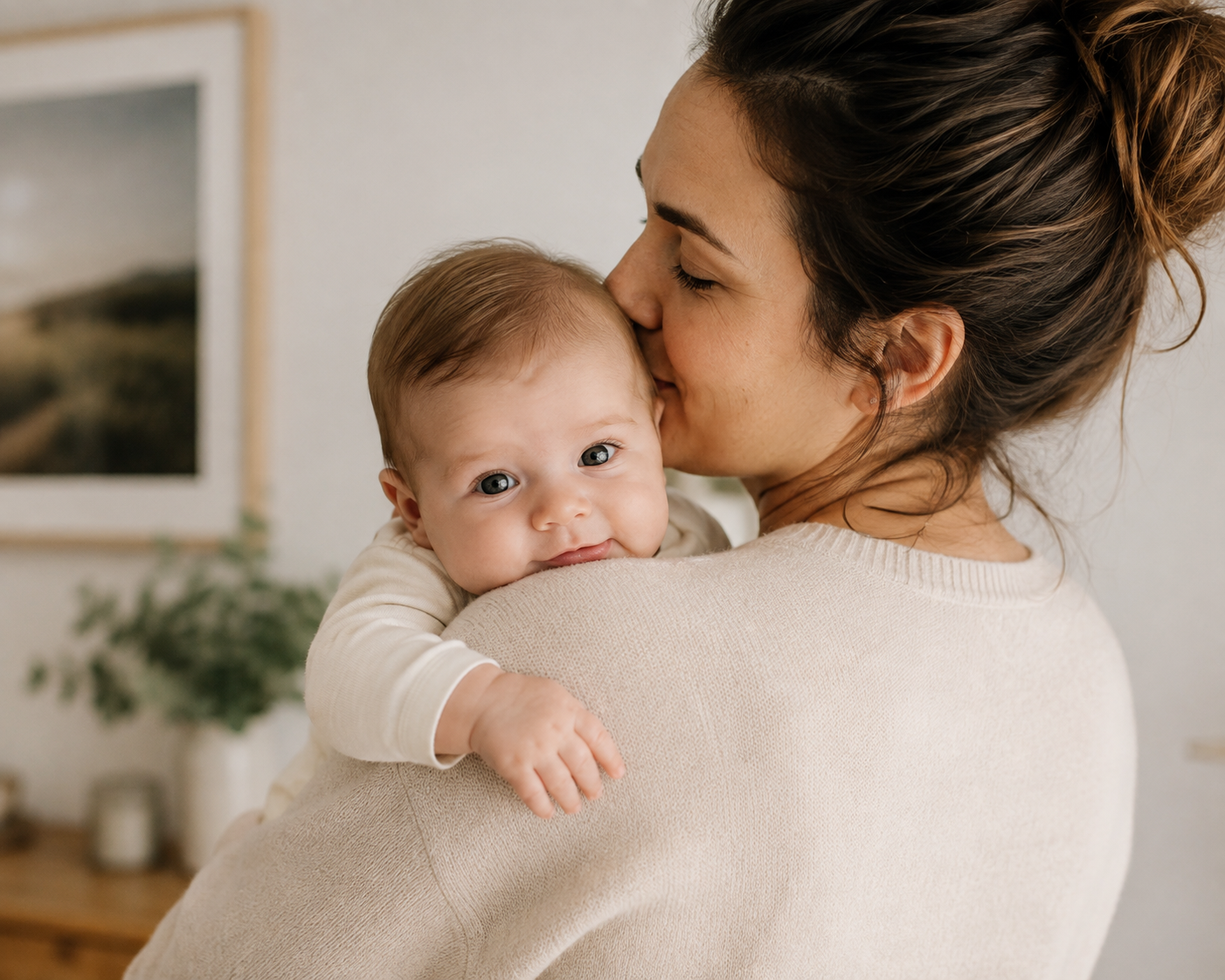
Why is my baby crying? And how can baby sign language help?
If you’ve ever looked at your crying baby and thought, “I wish you could just tell me what you need!”—you’re definitely not alone.
Crying is your baby’s earliest and most effective form of communication. They’re not trying to give you a hard time. They’re trying to tell you something.
I’m hungry. I’m tired. I’m uncomfortable. I need you.
The tricky part is that all of those messages can sound remarkably similar at 2am!
But something exciting happens during your baby’s first couple of years. Communication gradually moves from crying, to gestures (or signs!), to words and eventually sentences.
Before babies can talk, they can communicate.
Long before your baby says their first word, they’re developing communication skills.
They learn to look towards things they want, reach their arms towards you, point, wave goodbye and shake their head for “no”. These gestures are an important developmental step because your baby is beginning to understand something powerful:
I can do something that communicates a message to another person.
The challenge is that babies and young toddlers often understand far more than they can actually say.
They might know exactly what they want but simply don’t have the words to tell you yet.
That’s where signing can be incredibly helpful.
Baby sign language gives little hands a way to talk
Baby sign language—or Key Word Sign using Auslan signs—builds on something babies are already naturally doing: communicating with their hands and bodies.
Instead of relying on crying, reaching or pointing, your baby can begin learning simple signs for meaningful words such as:
MORE. EAT. DRINK. MILK. HELP. FINISHED. MUM. DAD.
Imagine your toddler becoming frustrated because they can’t open a container. Instead of immediately crying or throwing it, they sign HELP.
Or your baby finishes their banana, looks at you and signs MORE.
That’s a pretty big communication win!
But won’t signing stop my baby from talking?
This is one of the most common concerns parents have about baby sign language.
Signing isn’t intended to replace speech. We sign and speak at the same time.
When you say “more” while making the sign for MORE, your baby receives the message in two ways: they hear the word and see the sign.
Over time, as their speech develops, spoken words increasingly become their easiest way to communicate and signs may naturally reduce.
Think of signing as a bridge—not a destination.
Crying → gestures → signs → spoken words → sentences.
And every stage is helping your child understand that communication works.
Signing can help reduce communication frustration
Anyone who has lived with a toddler knows that big feelings can arrive very quickly!
Sometimes what looks like “bad behaviour” is actually a child communicating the only way they currently know how.
When children have an effective way to communicate more, finished, help, or drink, we give them another option.
It doesn’t mean signing magically eliminates every toddler meltdown—if only! But it can remove some of the frustration that comes from knowing what you want without being able to tell anyone.
Start with just a few signs
You don’t need to become fluent in Auslan or teach your baby dozens of signs overnight.
Start with a handful of words that matter in your baby’s everyday life.
Choose words they are motivated to communicate, use the sign every time you say the word and keep talking normally.
Most importantly, keep it relaxed and fun.
Your baby’s journey towards talking starts long before that magical first word. By responding to their cries, noticing their gestures and introducing simple signs, you’re showing them something incredibly important:
Your communication matters. I’m listening. And I want to understand you.
