
Top 5 signs to start with and why!
Ha! When I started this post, I thought – this will just be a super quick blog… but I turns out I like to teach – it’s just who I am. So it’s a bit longer than I thought. If you’d prefer a quick YouTube tutorial, you can watch these 5 signs here.
Hopefully you have already read my blog The benefits of baby sign language, if not definitely have a quick read of that too, so you understand why you should add baby sign language to your daily routine.
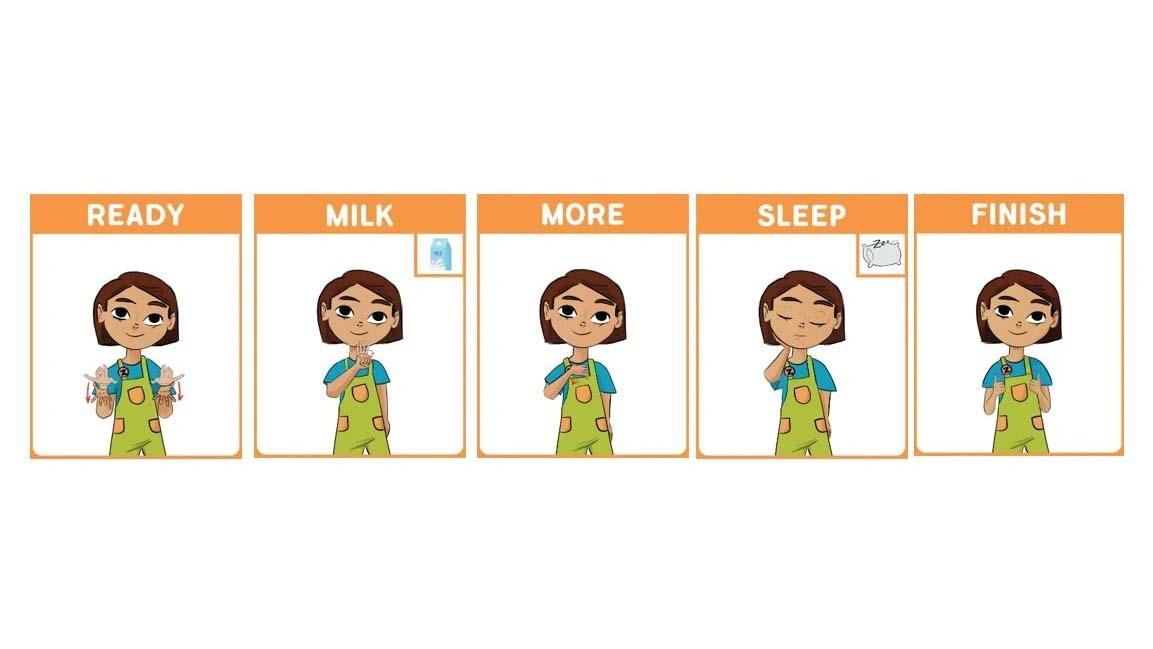
My top 5 signs to start using today with your infant, and why!
1: Ready – Touch the pads of your middle finger, to the pads of your thumbs. Palms facing upwards, elbows bend at 90 degrees. Flick your fingers open as you move your hand downwards slightly.
Why? Using a cue like “Ready” supports your baby’s awareness that something is about to happen. The world of a baby can be confusing and unpredictable, as they don’t yet understand what is happening around them. Providing this visual and verbal cue, allows your baby to understand: OK – I need to concentrate, something is about to change or happen. It also opens the door to consent. If you are playing a game, you can ask your child “Are you Ready?” And wait for their confirmation before proceeding with the game.
2: Milk – using your dominant hand, open and close your hand making a first, then releasing.
Quick note on this – this is not the official Auslan sign for Milk. However, it is a variation that is widely used in the Deaf community. The official signs for milk is with two hands, somewhat like if you were to milk a cow. Using one handed variations is common.
Why? Well, baby’s world revolves around milk, so this is likely going to be one of, if not THE first sign they learn. And it’s so helpful. It will allow your baby to be active in their world, to ask for what they want and need. This builds self-esteem and confidence.
3: More – using your dominant hand, open all five fingers, then slightly bend your knuckles – a bit like you’re catching a ball. Then place the tips of your fingers in the middle of your chest and move your hand outward, about 5-10cm.
Why? As with all signs, this give your baby the ability to actively contribute to their world. They might want more food, more books, more tickles. This sign can be used in a wide range of contexts to support your baby’s ability to be in control. Which is a great way to support their confidence and self-esteem, as well as make them feel powerful (which, you’ll be glad to know, supports better behaviour).
4: Sleep – Place one or two hands on the right side of your face, tilting your head to the right slightly.
Why? Because it is so helpful if a baby can tell you exactly what they want. If your baby wants to sleep, you want to know. While the ability to actually understand these biological cues (i.e. identify feelings of hunger, tired, etc.) don’t typically come in until around the 2ndbirthday, giving your baby the language to tell you when they want to sleep is very helpful. And the sheer act of teaching them these words and signs actually helps them develop the skill of identifying the feeling in themselves.
5: Finish – Two thumbs up, in front of your body, elbow bend at 90 degrees. Pivot wrists left to right (shaking).
Why? Similarly to including the sign “Ready”, explicitly highlighting when an activity is finished will help your baby feel safe in what can be an unpredictable and confusing world for them. Remember, everything for your baby is new. Everything. So, if they start to cry when you are leaving the house, it’s probably because they don’t understand why all of a sudden they are being bundled up and out the door. This is a really wonderful, diverse sign that can be used throughout your day – when you finish reading a book, changing a nappy, eating a snack, or playing a game. I recommend to families to use it every time your finish an activity and are moving on to the next. Soon enough your baby will understand the meaning and start using it to signal to you that they are finish and ready to move on. Much tidier than throwing their bowl across the kitchen.
So, there you have it. My top 5 signs to start using with your baby today! If you’re wondering what age to start signing, have a look at my other blog “When is the best time to start signing with your baby?”
If you’re a visual learner, you can also check out this YouTube video I made that also SHOWS you have to do these signs.
Happy signing!
– Meg –
