
School Readiness Starts Early: How KWS Can Help
When we hear the words “school readiness,” many parents think about children knowing their letters, counting to 20, writing their name or recognising colours. But as early years professionals, we know there’s so much more to it than that.
Often we focus on children in the final year before they start school – the kindy year – as the time to start supporting them to be “school ready”… but the reality is that the skills needed to be school ready start much earlier than that.
Some of the most important foundations for school readiness are communication, language and social skills. Children need to be able to understand what is happening around them, communicate their needs, interact with other children, follow routines and participate in learning.
And this is where Key Word Sign can be incredibly valuable.
Communication comes before academics
Imagine arriving in a classroom and not being able to understand what people are saying—or knowing what you want to say but not being able to get the words out.
Learning would be pretty difficult!
Before children can engage confidently with early literacy, numeracy and other classroom learning, they need strong foundations in communication.
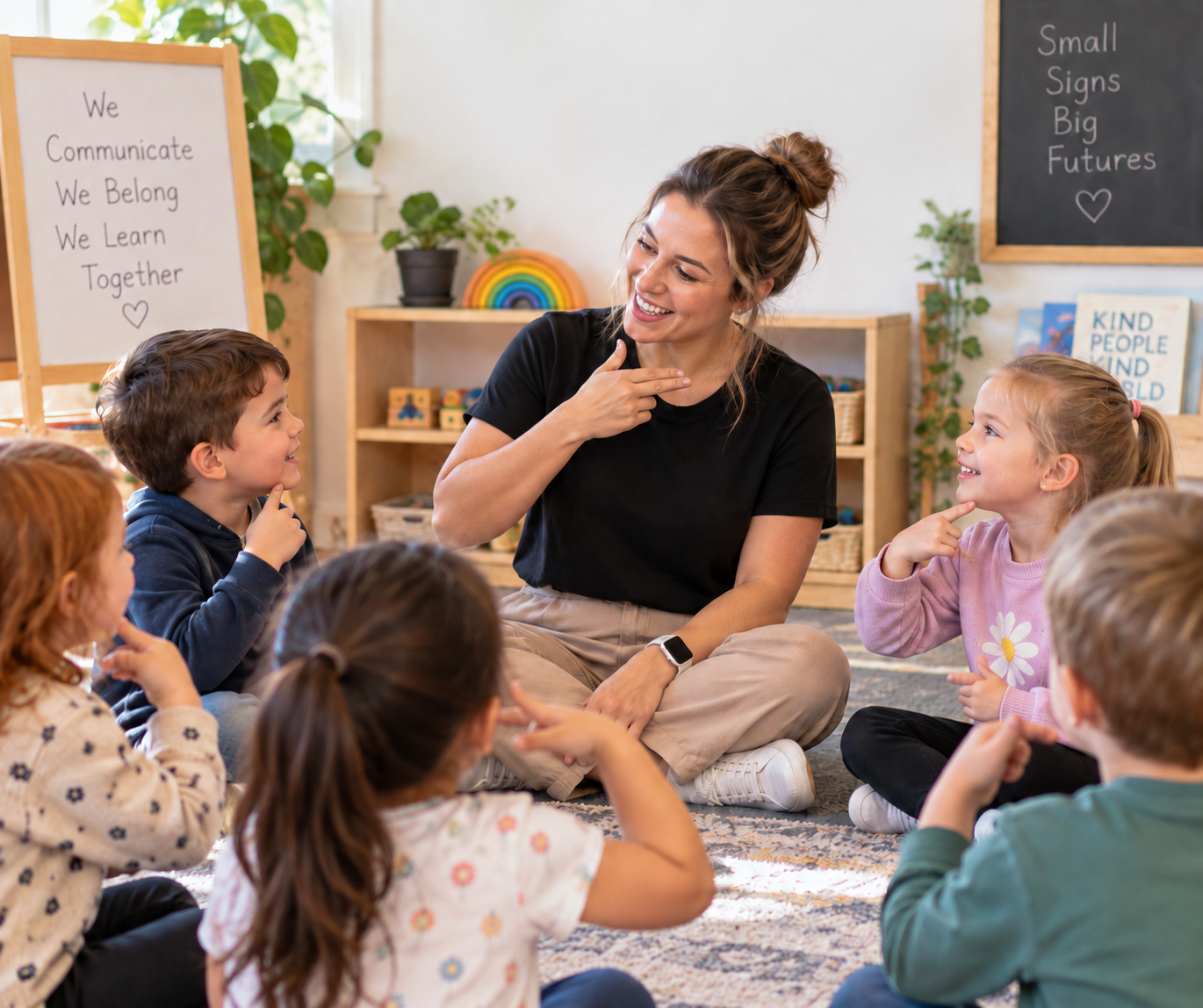
Key Word Sign uses signs alongside spoken language, with the most important words in a sentence supported by signs. In Australia, Key Word Sign uses signs borrowed from Auslan (Australian Sign Language).
For example, an educator might say, “FIRST we PLAY, THEN we EAT,” while signing the important words.
This gives children both an auditory and visual cue to help them understand what is being said.
Supporting children to understand language
Early childhood environments are full of language.
“Come and sit on the mat.”
“Wash your hands before lunch.”
“Wait for your turn.”
“First pack away, then we’ll go outside.”
For children who are still developing their language skills, these instructions can be difficult to process. Key Word Sign adds a visual layer to spoken language, helping to highlight the words that carry the most meaning.
And importantly, children don’t have to be using signs themselves to benefit from seeing adults use them.
Helping children express themselves
School readiness is also about being able to communicate with other people.
A child needs ways to say help, more, finished, stop, toilet, hurt, my turn or I don’t like that.
For children whose speech is still developing, Key Word Sign can provide another way to get their message across.
Being understood matters.
When children have an effective way to communicate, we can often reduce the frustration that comes from knowing what they want but not yet having the spoken words to express it.
Building social skills
Communication isn’t just about asking for things. It helps children connect with other people.
Key Word Sign can support children to participate in everyday social interactions such as greeting friends, requesting a turn, sharing, making choices, asking for help and expressing emotions.
These are exactly the kinds of skills children will use every day when they arrive at school.
Creating foundations for literacy
Long before children learn to read, they are developing the language skills that literacy will eventually be built upon.
Talking, listening, understanding words, learning new vocabulary, sharing books, singing songs and participating in conversations all contribute to later literacy development.
When we pair spoken words with signs, we’re giving children another way to engage with language and helping draw their attention to important words and concepts.
School readiness starts now
We don’t need to wait until the year before school to start thinking about school readiness.
Every conversation, song, story, interaction and playful moment in the early years is helping build the communication skills children will eventually take into the classroom.
By incorporating Key Word Sign into everyday routines, early childhood educators and families can create communication-rich environments where more children have opportunities to understand, participate, connect and communicate.
Because being school ready isn’t just about knowing ABCs and 123s.
It’s about having the communication skills to join in, learn and belong.
